What Is The Mini Max Strategy?
Wonder what the Mini Max term means? It’s kind of a big deal and way more important for your success as a trader that you may think. So, do not under estimate how influential reading this article might be for your longevity as a trader. The Mini Max is a religious process to be respected.

September 24, 2021
0
min read

What Is The Mini Max Concept?
As the video below describes, it boils down to the following quote:
“In a zero sum game, the best strategy to pursue when you are up against a sophisticated opponent is one that minimizes your maximum loss.”
In other words, no matter how sophisticated your opponent is, what matters is to guard yourself against the worst thing that can happen in case of a loss. Not only that, but that’s the best move you can do in a zero-sum game.
This is a concept I also emphasize in my mentor room. Notice what I mention in point #4 of the post below? Only accept small losses but not large ones.

This chart below illustrates the application of the Mini Max strategy. I took a breakout trade that failed to play out. Despite my maximum loss I’d accept is the total size of the red box (‘emergency stop loss’), the moment I gathered sufficient evidence that the trade didn’t follow through and the magenta box was re-taken by the selling pressure, I MINI-mized the MAX-imum damage.

#1 Rule In Risk Management — Avoid Large Losses
Should you invite ‘large losses’ as part of the equation, there is going to be far greater probabilities for an overall negative PnL curve.
Remember, this train of logic originates from the very premise that trading financial markets is a zero-sum game against a tough opposition.
If one accepts the above as true, expecting a very high win rate must come at the expense of losing big when the trade doesn’t play in your favor.
If, on the other hand, one accepts odds of winning at or slightly above the 50% vicinity, the best formula for success in the markets, especially for those that engage in active speculation, comes from controlling the downside.
The Psychology Behind Taking Losses
Why is taking losses a hard concept to grasp for humans? Because we are inherently flawed. We have a tendency to avoid painful experiences by all means, and since most humans associate a loss with an undesirable outcome, it results in letting losses run far longer than they should.
The reason for this is that negative events have a greater impact on our brains than positive ones. Psychologists refer to this as the negative bias, to the point that it alters our behavior and clouds our judgement in doing the thing that we know should be done in the first place, that is, deploying tactics around risk mitigation. That’s where the Mini Max strategy comes in.
This is what I wrote in my mentor room back in July:
“If you seek constant security, you will inevitably find it tremendously hard get past the negative emotions of taking a loss. This is very rooted within the human brain. From an early age, we have been taught to do the right thing, and avoid doing the wrong thing. So no wonder we associate a loss with a negative outcome that triggers within us do whatever it takes to avoid being proved wrong in the market. Now, if your position size is far too big, that feeling of false hope for the market to turn around gets only amplified. Why? Cause you can’t accept taking such a big loss. It’s far better to remain positive and optimistic and hope that a losing position turns around, isn’t it? Again, is completely counterproductive to our chances of success. It’s simply statistics!”
We should completely reverse our train of thought to not worry about the profit but to be obsessed about the loss. If you keep the losses small then the upside tends to sort itself out as it is in such occasions that we re-calibrate our focus from minimal to maximal extraction of our next bet.
Gambler’s Ruin
As Wikipedia defines it: “A gambler with finite wealth, playing a fair game (that is, each bet has expected value zero to both sides) will eventually and inevitably go broke against an opponent with infinite wealth (the market).”
In a recent conversation within Global Prime’s Discord room, Norm from Tip Toe Hippo, an automated trading business for retail traders, mentioned:
“When the mathematics is teased out what it breaks down to is that the probability of going broke is dependent on your bank vs the opponent’s bank. Given that the market’s bank is basically infinite- even with a probability edge the chance of going broke is significant. So if you have an edge, that is simply not enough- you are still overwhelmingly likely to go broke unless you minimize the difference between your and your opponent’s banks (and this basically means increasing the amount of ‘turns’ you can play for with your edge advantage).”
I couldn’t agree more. Risking less gives you more opportunities to participate and let your edge play out. This must be a core understanding as it lays out the fundamental reason behind why retail traders need to risk less.
Risk of Ruin
Another concept critically important to introduce which complements the gambler’s ruin is the risk of ruin. I find the risk of ruin is expressed through a statistical model that calculates the probabilities of losing it all.
As Wikipedia describes it: “Risk of ruin is the likelihood of losing all one’s investment capital below the minimum for further play. For instance, if someone bets all their money on a simple coin toss, the risk of ruin is 50%.”
You must develop an obsession towards the management of risk. If you don’t, a high win rate and risk-reward ratio alone may not cut it.
The risk of ruin theory, when addressed, allows you to find a risk level that is within the acceptable limits to avoid blowing up your account.
Once you have projected your sweet spot as part of the risk of ruin, you now can understand the level of risk you can afford per each trade, so that you essentially nullify the probability of losing your account.
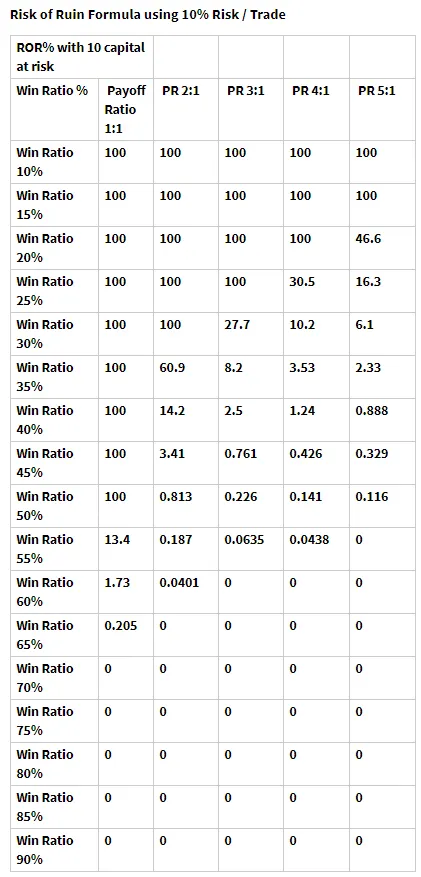
Let’s look at an example risking 10% per trade:
Let’s look at an example risking 2% per trade:

Risk of Ruin Calculator | Forex Tools & Resources — 2ndSkiesForex
Let’s now interpret the numbers. In a hypothetical strategy with a win rate expectancy of 50% and the trader aiming for a 1:1 risk reward, the risk of blowing up one’s account regardless of the amount at risk (10% vs 2%) is still the same, 100%. Main take away? Find a combination where the risk of ruin is either 0 or low enough for you to accept but certainly not 100%.
What if the trader decides to utilize a trading system with a win expectancy of 40% and risk reward of 2:1. Here is where the magic of statistics starts playing out. With a risk of 10%/trade, which is an unacceptable percentage, the risk of ruin would be 14.2%. On the flip side, under the same scenario, by trading only 2% risk/trade, one can fully eliminate the risk to 0%.
Moral of the story: You must find a level of risk that is appropriate to your projected win rate and risk reward. As a rule of thumb, it’s broadly acceptable in the industry a threshold of 1–2% per trade as the absolute maximum.
Mini Max Pays Off — Be Obsessed With It
As the famous saying goes, “Cut your losses short and let your profits run.” In this article, however, it is the first part of the quote that is at the core.
A small loss is the humbling action taken that recognizes we got it wrong in a game highly competitive amid a randomized distribution of events when looking at a small sample of trades. Add into the mix that we are up against a sophisticated set of adversaries with far more resources. You get the picture?
Knowing where to draw the line for an exit lays the strongest foundation to then embrace opportunities when profits come about. The Mini Max is therefore one of the key building blocks to a more prosperous trading career.


4.4/5

4.7/5

4.5
Trade Global CFD Markets
Trade Over 250 Instruments from Around the World.
Ready to Start Trading?
Back yourself with a #1 Rated Broker*

Fund your account with over 20+ instant deposit methods. AUD, CAD, EUR, GBP, JPY, SGD or USD - save on conversions!






Start Trading
Trading Accounts
CFD Markets
Trading Conditions
Trading Tools



Trading derivatives carries a high level of risk to your capital and you should only trade with money you can afford to lose. Any Information or advice contained on this website is general in nature and has been prepared without taking into account your objectives, financial situation or needs. Past performance of any product described on this website is not a reliable indication of future performance. You should consider whether you’re part of our target market by reviewing our Target Market Determination, and read our PDS and other legal documents to ensure you fully understand the risks before you make any trading decisions. We encourage you to seek independent advice if necessary. Global Prime is not able to take clients from Afghanistan, Congo, Iran, Iraq, Myanmar, New Zealand, North Korea, Palestine, Russia, Somalia, Sudan, Syria, Ukraine, Ontario, Yemen, Japan or the United States or its territories. The information on this website is not intended to be an inducement, offer or solicitation to any person in any country or jurisdiction where such distribution or use would be contrary to local law or regulation. Global Prime is a trading name of FMGP Trading Group Pty Ltd (ABN 74 146 086 017) and is regulated in Australia under Australian Financial Services License No. 385620.
© Copyright year FMGP Trading Group Pty Ltd Level 10, 627 Chapel St, South Yarra 3141 Australia. All trademarks, service marks, trade names, trade dress, product names and logos appearing on the site are the property of their respective owners.
*Based on a May 2025 survey by forexpeacearmy.com among brokers with at least 100 reviews. Find more information about ratings and reviews here.
^Awarded “Best Execution Broker 2025” by TradeProofer unparalleled trade execution, transparency, and client-focused service.